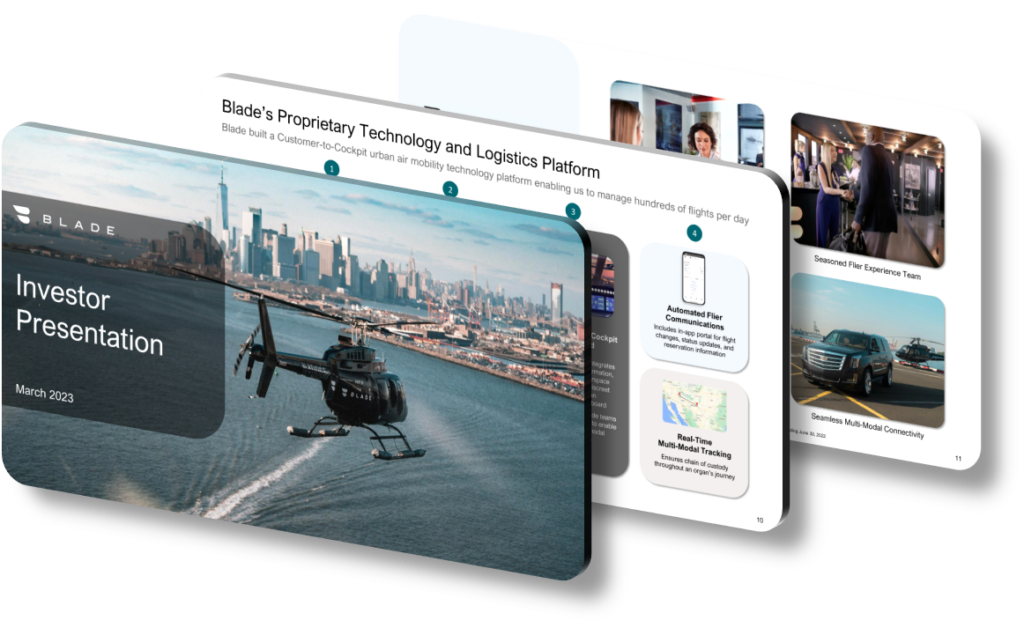
A presentation designed around urban air mobility solutions tends to highlight key offerings because the sector is highly technical, investment-driven, and still emerging — meaning audiences need rapid orientation before they can evaluate claims. When a company in the aerial ridesharing or electric vertical takeoff and landing (eVTOL) space builds its slide deck, it must quickly establish credibility, demonstrate market readiness, and distinguish its fleet or route network from competitors. Highlighting specific solutions — such as helicopter-to-eVTOL transition timelines, fixed-cost per-seat pricing models, or vertiport infrastructure partnerships — gives institutional investors and regulators concrete anchors rather than abstract promises.
Urban air mobility (UAM) is a fast-moving field where the gap between vision and operational reality is enormous, and presentation design choices reflect that tension directly. Founders and executives in this space use visual hierarchy, bold statistics, and route-map graphics to compress complex logistics into digestible frames. For example, a slide might foreground average flight time reduction (say, 8 minutes vs. 45 minutes by road for a specific city corridor) rather than burying it in a footnote. This is intentional design strategy: audiences at investor days, aviation conferences, or regulatory hearings are evaluating whether the company can solve a real urban congestion problem at commercial scale, so the design must answer that question within the first two or three slides.
There is also a trust-building dimension rooted in the unique regulatory environment of UAM. Federal Aviation Administration certifications, Part 135 air carrier approvals, and noise-level compliance thresholds are not optional talking points — they are the infrastructure of credibility. A well-designed presentation places these certifications prominently because stakeholders (airport authorities, city planners, insurance underwriters) need to see compliance evidence before they engage operationally. Poor presentation design in this context often buries safety data in appendices or presents it with generic stock photography, which signals to experienced aviation investors that the operator does not understand its own risk narrative.
- Lead with a specific route and measurable time savings — for example, showing that a defined metropolitan corridor is reduced from 52 minutes by car to under 10 minutes by air, grounding abstract claims in a real geography stakeholders recognize.
- Visualize the fleet transition roadmap explicitly, distinguishing current helicopter operations from planned eVTOL integration timelines, including projected certification milestones and expected passenger capacity by year.
- Use a dedicated slide for regulatory compliance achievements — including Part 135 approvals, noise decibel ratings, and any FAA Beyond Visual Line of Sight (BVLOS) waivers already granted — to establish operational legitimacy early in the deck.
- Incorporate network-effect diagrams that show how adding a second or third vertiport node multiplies route options exponentially, helping non-technical investors grasp scalability without requiring aviation expertise.
- Present unit economics per seat-mile with real cost benchmarks, distinguishing fixed infrastructure costs from variable fuel or battery costs, so analysts can model profitability scenarios using their own assumptions.
- Include a competitive differentiation matrix that maps the company’s current operational status against peer UAM operators using dimensions like seats per flight, range in miles, and cities currently served.
- Close with a city-level demand slide backed by third-party commuter data or municipal transportation authority statistics, which signals that market sizing is grounded in verifiable public records rather than internal projections alone.
The practical takeaway is that highlighting urban air mobility solutions in presentation design is not decorative — it is a direct response to the informational needs of the specific audiences these companies address. If you are building a similar deck, prioritize specificity over breadth: one well-documented route with real operational data will outperform five speculative future markets. This approach is less effective, however, if your audience is general public media rather than investors or regulators, where storytelling and lifestyle framing tend to outperform data-dense slides. Know your room before you finalize the hierarchy of what gets highlighted.
Need a presentation that wins the room? SlideGenius designs custom, high-impact decks for brands like Red Bull, Amazon, and Adidas. Browse our presentation design portfolio, explore our PowerPoint design services, or contact us for a free quote.