When a brand team first sees Copilot generate slides “in their template,” the reaction is usually one of two things. Relief, because the colors and logo are right. Or confusion, because the slides are clearly in the template and yet look nothing like the decks the team actually makes.
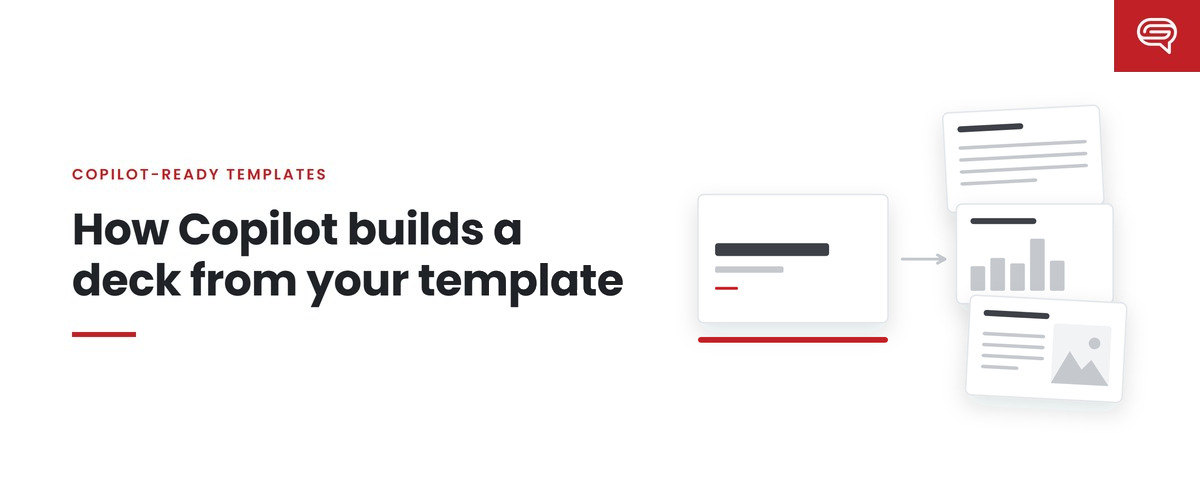
Both reactions come from the same misunderstanding. Copilot does not copy a template. It learns from one. And a template built for people to use by hand often has very little in it for a model to learn from.
This post walks through what Copilot actually reads when it builds from your template, using Microsoft’s own guidance, and what that means for how templates should be built from now on.
A template has three layers, and Copilot uses all of them
Think of a PowerPoint template as three layers stacked on top of each other.
The theme sits at the bottom. It defines your theme colors and your heading and body fonts. Anything that references the theme — a chart, a shape, a table, a text style — picks up those definitions automatically.
The Slide Master and its layouts sit in the middle. The Slide Master is the top slide in Slide Master view, and anything defined on it is inherited by the layouts beneath it. Each layout is a reusable arrangement of placeholders: a title here, a picture there, a body area on the right.
The sample slides sit on top. These are real, finished slides built on those layouts, showing how the brand is used in practice.
Copilot draws on all three. But not equally.
Sample slides are the main teaching material
Microsoft’s guidance is unusually direct on this point. It recommends that templates include representative sample slides across the kinds of slides your organization actually makes — title, agenda, section dividers, content slides with text, icons and images, data visualization, timelines, processes, quotes, summaries and closing slides — and that those examples show different amounts of content: light, medium and heavy.
It also says what happens when those examples are missing: “If your template does not contain enough sample slides, Copilot falls back to the Slide Master — which may result in less optimal output.”
That sentence explains a lot of disappointing Copilot output. The template has forty beautifully named layouts and not a single finished example. Copilot has the architecture but not the behavior. It knows where a title goes. It has no idea how your company uses a two-column comparison, how dense your data slides usually are, or when you use a full-bleed photograph.
A useful way to think about it: layouts tell Copilot what is possible. Sample slides tell it what is normal.
Placeholders tell it where things go, not what to say
The second thing Copilot reads is placeholders. Microsoft’s documentation says Copilot “uses placeholder type, position, and size to determine what content should be generated and where it should appear.” It also says Copilot does not rely on the wording inside a placeholder to understand what the layout is for. Placeholder text is styling only.
Two practical consequences:
- Text boxes are invisible as structure. If your layouts use drawn text boxes instead of real placeholders, Copilot cannot treat them as slots to fill. Microsoft recommends text placeholders instead of text boxes, inserted through Slide Master > Insert Placeholder.
- Instructions typed into placeholders do nothing. “Insert key message here, max 12 words” is a note for a human. Copilot will not read it as a rule. If you want to give Copilot instructions, there are now proper places for them — speaker-note instructions and Brand Skills — which we cover in their own posts.
Placeholders also need room to work. Microsoft advises keeping them non-overlapping and not placing decorative elements over text or image areas. A layout where the photo placeholder sits under a decorative shape might look fine when a designer fills it carefully. When a model fills it, the result is often a clipped image or text colliding with artwork.
The theme carries your brand into everything
The third input is the theme. Microsoft recommends defining your colors through Slide Master > Colors > Create New Theme Colors, and your heading and body fonts in the theme, rather than formatting things by hand.
This matters because Copilot generates new objects — charts, shapes, text — that did not exist in your template. The only way those new objects can come out in your brand is if they inherit it from the theme. A color that is hardcoded onto one shape in one layout teaches Copilot nothing about when to use that color elsewhere.
Hardcoded colors are a common problem in corporate templates. The template looks right because a designer painted every element by hand. The theme underneath is generic.
Where the Brand Kit comes in
If your organization uses Brand Kit, the template is uploaded there by a brand manager (as a .potx or .pptx file), alongside your colors, fonts, logos and approved imagery. When employees select that brand kit in the Copilot pane, Copilot works from the kit’s approved templates and assets.
Since September 2026, brand managers can also turn on strict brand adherence, which restricts Copilot to your approved template and slide master layouts, with no new layouts and no added or removed placeholders. Employees cannot override it.
That is a powerful control, and it raises the stakes on everything above. With strict mode on, Copilot cannot improvise its way around a weak layout. Whatever the template gets wrong, every generated deck gets wrong too.
What this means for how templates are built
For most of the history of corporate templates, the audience was a person: someone who opened the file, picked a layout, and used judgment to fill it in. Weaknesses in the template were absorbed by that person’s judgment.
Now there is a second audience that has no judgment of its own to fall back on. It learns from what is in the file, and it applies what it learned at a scale no design team could review. So the questions a template owner should ask have changed:
- Does every slide type we actually use have a finished example, at more than one density?
- Is every content area a real placeholder, sized and positioned for the content it will receive?
- Does every color and font come from the theme, rather than from hand formatting?
- Would a model looking at our examples learn how we communicate, or only what our logo looks like?
None of these are exotic. They are the same things a careful designer has always cared about. The difference is that they used to be nice to have, and now they determine the quality of every deck your employees generate.
Key takeaways
- Copilot learns from three layers: sample slides, placeholders and the theme.
- Sample slides are the primary teaching material. Without enough of them, Copilot falls back to the Slide Master.
- Placeholders define where content goes, not what it says. Placeholder wording is ignored as instruction.
- Theme colors and fonts are the only way new objects Copilot creates can come out in your brand.
- Strict brand adherence makes the template a rule. That rewards good templates and multiplies the cost of weak ones.
Curious what your template is teaching? Have your template scored.**
Related reading
Sources
- Microsoft Support, Keep your presentation on-brand with Copilot (July 2026)
- Microsoft Support, Manage template settings in your Brand Kit for Copilot in PowerPoint (August 2026)
- Microsoft 365 Message Center, MC1470415 (10 Sep 2026)