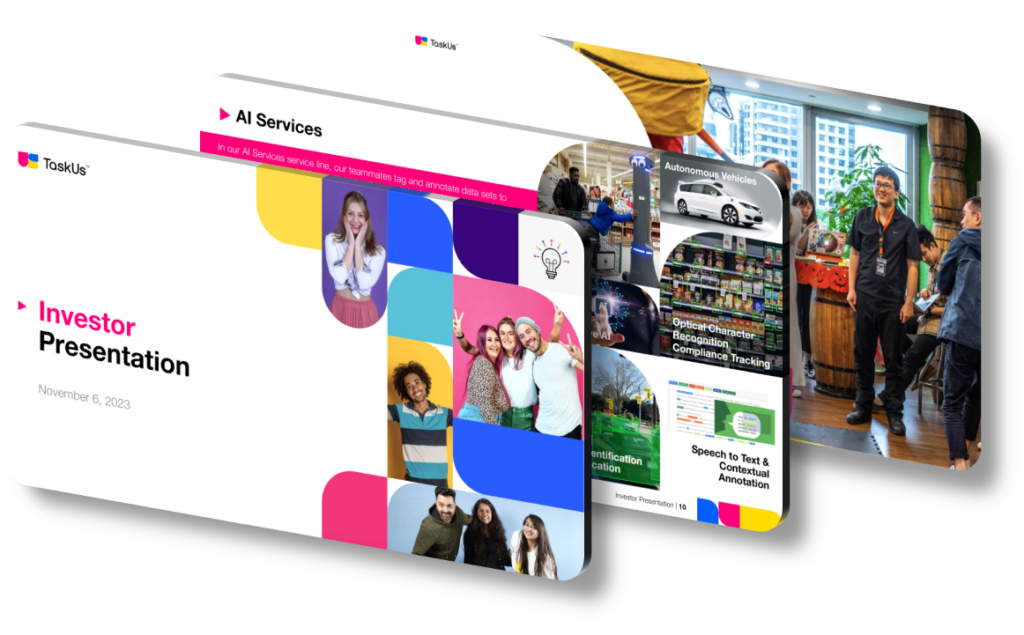
A November 2023 presentation designed to highlight innovation in business process outsourcing (BPO) services typically combines forward-looking visual frameworks with concrete performance data to signal that the company has moved beyond traditional cost-arbitrage positioning. Rather than simply listing service lines, an innovation-focused BPO deck structures its narrative around transformation pillars — such as AI-augmented workflows, digital quality assurance, and outcome-based pricing — so that every slide reinforces the message that the provider is a strategic growth partner, not just a low-cost labor vendor. This structural choice immediately differentiates the deck from commodity BPO pitches.
The design language itself carries strategic weight in this type of presentation. Innovation-forward BPO decks from late 2023 frequently abandoned dense text slides in favor of ‘capability maps’ that visually cluster automation tools, human expertise layers, and analytics dashboards into an integrated ecosystem diagram. Color palettes shifted toward tech-sector conventions — deep navy, electric teal, and clean white — rather than the conservative blues and grays historically associated with outsourcing firms. Typography choices leaned sans-serif and geometric, reinforcing a sense of precision and modernity. These visual signals are deliberate: they borrow credibility from software and SaaS company aesthetics to reposition BPO as a technology-enabled discipline rather than a headcount-driven one.
Content strategy in a high-impact November 2023 BPO innovation deck goes beyond case study slides. The strongest versions of this presentation format integrate three specific content pillars: first, a ‘current-state versus future-state’ comparison that quantifies automation adoption rates (for example, showing that AI-assisted ticket resolution reduced average handle time by 35% in pilot programs); second, a talent transformation section that addresses upskilling metrics, showing how frontline agents are trained on tools like real-time sentiment analysis dashboards; and third, a forward roadmap that commits to measurable milestones for the next 12–18 months. This trifecta of proof, capability, and commitment structure is what separates an innovation narrative from a generic capability deck.
- Opening with a ‘disruption benchmark slide’ that shows industry-wide automation adoption rates versus your own adoption curve establishes credibility before any product or service claim is made.
- Using a ‘workforce augmentation model’ diagram — where human roles are shown wrapping around AI core functions — visually communicates that technology enhances staff rather than replacing them, addressing a common client concern.
- Including a specific pilot result, such as a customer satisfaction score improvement from 74% to 89% after deploying a real-time agent coaching tool, grounds abstract innovation claims in verifiable outcomes.
- Dedicating one slide to a ‘technology stack transparency layer’ that names the categories of tools in use (machine learning models, robotic process automation, conversational AI) builds trust by showing clients the engine, not just the result.
- A ‘co-innovation roadmap’ slide that invites clients to contribute to product development cycles signals partnership maturity and differentiates from vendors who only offer fixed service catalogs.
- Embedding a short animated data visualization — even as a looping GIF within a PowerPoint — showing real-time quality-score fluctuations across a simulated campaign demonstrates analytical sophistication far more vividly than a static bar chart.
- Closing with a ‘value realization timeline’ that maps expected ROI milestones at 30, 90, and 180 days gives procurement stakeholders a concrete evaluation framework, reducing sales cycle friction.
The practical takeaway is that a November 2023 BPO innovation presentation succeeds when design and content work as a unified argument, not as separate deliverables handed off between teams. If you are building or evaluating a similar deck, prioritize quantified pilot outcomes over aspirational language, and ensure every visual element reinforces the technology-plus-human positioning. This approach is most effective when pitching to enterprise buyers who have already evaluated commodity BPO providers; it is less relevant when addressing SMB clients who are primarily motivated by cost reduction and simplicity rather than strategic transformation partnerships.
Need a presentation that wins the room? SlideGenius designs custom, high-impact decks for brands like Red Bull, Amazon, and Adidas. Browse our presentation design portfolio, explore our PowerPoint design services, or contact us for a free quote.