For as long as organizations have had brands, presentations have been the leakiest part of them. Websites go through agencies and approvals. Ads go through legal. Presentations are made by everyone, in a hurry, from whichever file they had open last. Brand teams have always known this and mostly accepted it, because policing thousands of decks by hand was never possible.
Generative tools change the shape of the problem. When every employee can produce a polished-looking presentation in minutes, the volume of branded material leaving the organization goes up, and the traditional safety net — a designer catching problems — catches a smaller share of it. At the same time, the tools give brand teams a new kind of control they never had before.
This post is about using that control well.
Why consistency gets harder first
Three things happen when employees start generating decks.
Volume rises. People make decks they previously wouldn’t have bothered with, and they make them faster.
Polish hides problems. A hand-built deck with the wrong colors looks wrong. A generated deck can look finished — clean layout, confident typography — while using an outdated image, a non-standard color on its charts, or a structure nobody in the brand team would choose.
Fewer decks pass through experts. The whole point is that employees don’t need a designer for routine work. So fewer decks get a designer’s eye before they’re sent.
If brand consistency depends on review, it will decline. There simply isn’t enough review to go around.
Why it can get better than ever
Here’s the opportunity. For the first time, the thing producing most routine decks can be governed centrally.
Microsoft 365 Copilot gives brand teams several levers:
- An official Brand Kit, controlled by designated brand managers, holding the logos, palettes, fonts, imagery, templates and voice guidance Copilot uses when employees select the brand.
- Strict brand adherence, introduced in September 2026, which restricts Copilot to approved template and slide master layouts. Employees can’t override it.
- Note instructions, which put rules in template speaker notes — “Always include this cover slide,” “Don’t modify this slide,” “Keep the text minimal.”
- Brand Skills, rolling out from late September 2026, which publish written presentation rules across the organization.
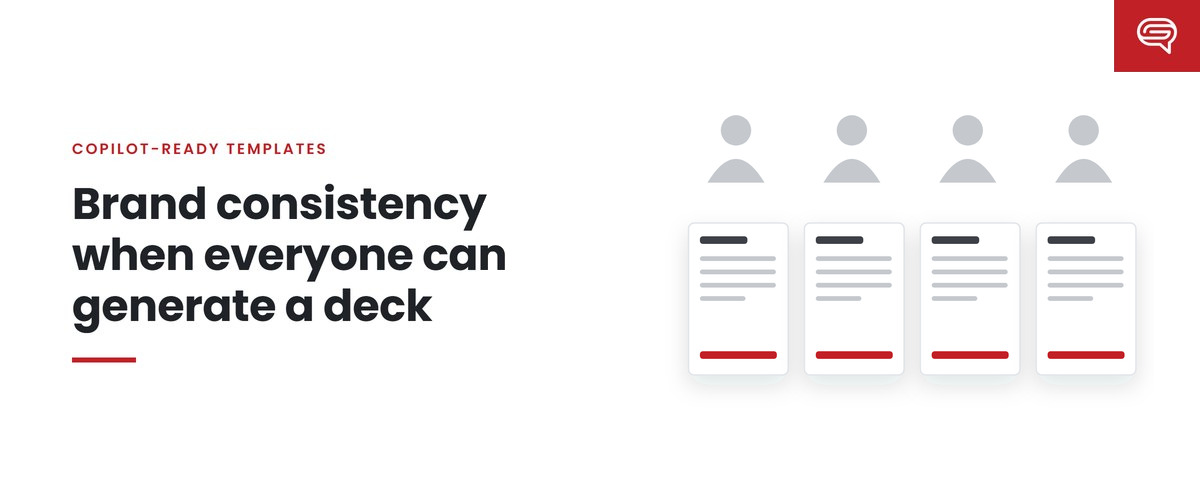
A human-made deck is only as consistent as the person making it. A generated deck is as consistent as the system it came from. That moves brand consistency from an enforcement problem — catching mistakes — to a design problem: building a system that doesn’t make them.
Consistency is more than colors
When people say “on brand,” they often mean the visible identity: logo, colors, fonts. Those are the easiest things to make consistent, because they live in the theme and the Brand Kit and apply automatically.
The harder layers are the ones that make an organization’s presentations recognizable as its own:
- Structure: how you open, how you make a recommendation, how you close.
- Density: how much you put on a slide, and when.
- Hierarchy: what you emphasize and how.
- Data style: how you present numbers — takeaway titles, highlighted statistics, clean tables.
- Imagery: what kinds of images you use and how you treat them.
- Voice: how slide titles and text are written.
These don’t live in a color palette. Copilot learns them from the template’s example slides — which Microsoft describes as its primary learning source — and from written rules in note instructions and Brand Skills. A template with a perfect theme and no examples produces decks that are consistent in color and inconsistent in everything else.
Building a consistent system
In order:
1. One source of truth. One official Brand Kit per real brand, and old templates retired. Consistency is impossible when three templates compete. Multiple official kits are supported — use them for genuine sub-brands, not for rival versions.
2. The brand in the theme. Colors, fonts and chart, table and shape styles defined in the theme so everything Copilot creates inherits them.
3. Examples of the deeper layers. Finished example slides showing your structure, density, hierarchy, data style and imagery, across the slide types your people actually make.
4. Rules for what examples can’t show. Voice, terminology, required and protected slides, density limits — in note instructions and Brand Skills, short and testable.
5. Deliberate enforcement. Strict brand adherence once testing shows the template covers real content.
6. Measurement. A fixed set of realistic prompts, run regularly, and a periodic sample of real generated decks reviewed for consistency failures.
What review is still for
Review doesn’t disappear; its purpose changes. Instead of checking every deck for brand errors — impossible at scale — brand teams review samples of generated output to find patterns, then fix the system that caused them. One fix to an example slide or rule corrects the pattern in every future deck.
Individual review still matters for high-stakes, external presentations. Microsoft’s own guidance is that Copilot output should be reviewed by a person, and the more a deck matters, the more that applies.
Common questions
Is brand consistency the same as brand compliance?
Not quite. Compliance means following the rules. Consistency means decks feel like they came from the same organization, which includes structure, density, hierarchy and voice, not just colors and logos. Rules help with compliance; examples do most of the work for consistency.
Can we lock everything down?
Strict brand adherence locks layouts, and note instructions can protect specific slides. But a generative model still makes choices inside those layouts. Microsoft’s guidance is that its output should be reviewed by a person.
What about teams that need their own look?
Organizations can have more than one official Brand Kit. Use that for genuine sub-brands with their own identities, not to let each team keep its own version of the same brand.
Key takeaways
- Generated decks raise volume, hide problems behind polish, and bypass designers, so review-based consistency declines.
- The same tools let brand teams govern routine decks centrally for the first time.
- Consistency is more than colors: structure, density, hierarchy, data style, imagery and voice are taught by examples and rules.
- Build one source of truth, a theme-defined brand, teaching examples, testable rules, deliberate enforcement and ongoing measurement.
- Review samples to fix the system; review individual decks when the stakes are high.
Want consistency built in rather than inspected in? Have your template scored.**
Related reading
- Strict brand adherence: what Microsoft’s template lock does and doesn’t do
- For IT: the settings are the easy half
- What creative teams get back when routine decks go to Copilot
Sources
- Microsoft Support, Create and manage official Brand kits (July 2026)
- Microsoft Support, Manage template settings in your Brand Kit for Copilot in PowerPoint (August 2026)
- Microsoft Support, Keep your presentation on-brand with Copilot (July 2026)
- Microsoft 365 Message Center, MC1473166 — Brand Skill support (16 Sep 2026)